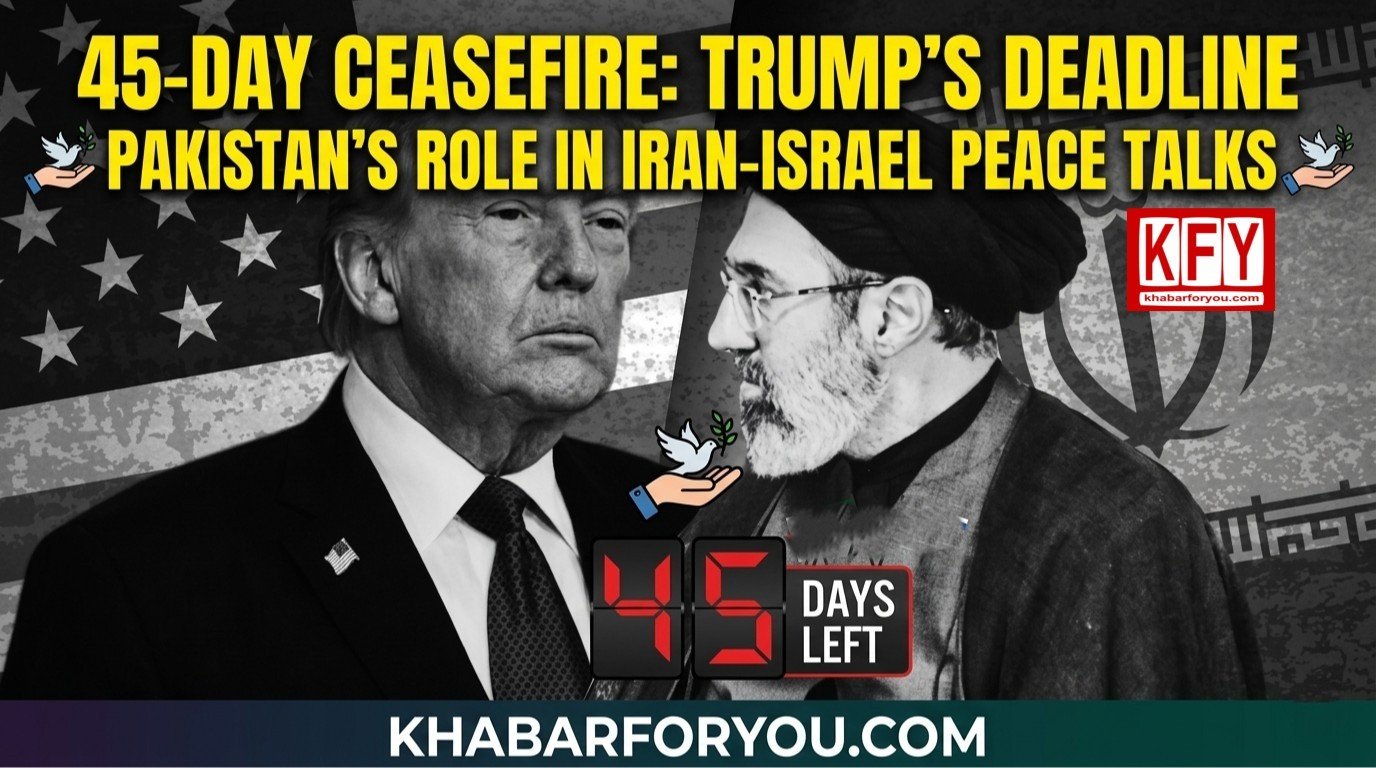
45-Day Ceasefire: Trump’s Deadline & Pakistan’s Role in Iran-Israel Peace Talks
- Khabar Editor
- 06 Apr, 2026
- 97232
Email:-infokhabarforyou@gmail.com
Instagram:-@khabar_for_you


As the Middle East teeters on the precipice of a full-scale regional catastrophe, a high-stakes diplomatic gamble is unfolding in the shadows. For the first time since the outbreak of the "West Asia War" 38 days ago, a concrete roadmap for peace - centered on a proposed 45-day ceasefire - is on the table. However, as of Monday evening, this "final opportunity" is being held hostage by a ticking clock and the uncompromising rhetoric of two old adversaries.
Read More - Where to Invest in 2026-27? Investigative Report on India's Economy & Markets
The 20-Hour Extension: Diplomacy Under the Gun
The urgency of the situation was underscored today when U.S. President Donald Trump extended his "ultimatum" to Tehran. Originally set to expire on Monday evening, the deadline has been pushed by 20 hours to Tuesday, 8:00 PM ET.
The President’s message, delivered via Truth Social and subsequent interviews, remains a blend of optimism and existential threat. “There’s a good chance for a deal,” Trump stated, before pivoting to a chilling warning: if the Strait of Hormuz is not reopened and terms are not met, “hell will rain down.” The U.S. has reportedly finalized "Power Plant Day" and "Bridge Day" strike packages, targeting Iran's entire civilian infrastructure.
The ‘Islamabad Channel’: Pakistan’s Central Role
Our investigation reveals that the center of gravity for these talks has shifted unexpectedly to Islamabad. A Pakistan-led mediation team, supported by Egypt and Turkey, is currently the primary conduit for messages between Trump’s special envoy, Steve Witkoff, and Iranian Foreign Minister Abbas Araghchi.
Sources close to the Pakistani Foreign Office suggest that Islamabad was chosen for its unique ability to maintain "functional trust" with both the IRGC (Islamic Revolutionary Guard Corps) leadership and the Trump administration. However, the path is fraught. Late on Sunday, reports emerged from The Wall Street Journal that Iran had officially rejected a proposal to meet U.S. officials face-to-face in the Pakistani capital, calling Washington’s current terms “unacceptable.”
The Two-Phase Framework: What’s at Stake?
The 45-day proposal, first leaked via Axios, is structured in two distinct stages:
1. Phase I (Confidence Building): A 45-day cessation of hostilities. During this window, Iran would be expected to allow partial traffic through the Strait of Hormuz and pause further enrichment of its uranium stockpile.
2. Phase II (The Grand Bargain): Broader negotiations to formalize a permanent end to the war, addressing the removal of Iran’s highly enriched uranium and a total lifting of the maritime blockade.
Tehran’s skepticism, however, is rooted in the "Gaza-Lebanon Precedent." Iranian officials have conveyed to mediators that they fear a temporary truce would merely allow the U.S. and Israel to refit their forces before resuming strikes. "Tehran is unwilling to surrender its primary leverage - the Strait of Hormuz - for what it sees as a short-term pause," says a regional security analyst.
The Economic Toll: $115 Oil and Global Inflation
While diplomats argue over clauses, the world economy is already feeling the shrapnel. Brent crude has surged past $115 per barrel. Shipping insurance for the Persian Gulf has become non-existent, and budget carriers like AirAsia X have already begun cutting flights. If the 45-day ceasefire fails, economists predict global inflation could hit levels not seen since the 1970s.
Military Escalation: The 'Daring' Rescue and Haifa Strikes
The backdrop to these talks is a series of escalating military engagements. President Trump recently claimed a "miraculous" rescue of a wounded American aviator from an F-15 downed over Iranian territory. Conversely, Tehran’s military command dismissed the claim as "propaganda," asserting the rescue mission was foiled.
On the ground, the human cost is mounting. A missile strike - allegedly launched from Iran - hit a residential building in Haifa today, while U.S.-Israeli strikes near the Bushehr nuclear plant have sparked fears of "radioactive contamination," according to a formal letter sent by Iran to the UN Secretary-General.
The Verdict: A Slim Margin for Peace
As of tonight, the "Pakistan Team" remains in constant contact with all parties. Qatar, usually a lead mediator, has reportedly stepped back, feeling the pressure of hosting a major U.S. base while being targeted by Iranian rhetoric. This leaves Pakistan, Egypt, and Turkey as the last line of defense against a total regional conflagration.
The next 20 hours will determine the fate of the 45-day ceasefire. If the Islamabad channel produces a signature, the world may breathe a sigh of relief. If not, the "Power Plant Day" threatened by the White House could mark the beginning of a conflict from which there may be no return.
Timeline of the 48-Hour Ultimatum:
Sunday, 10:00 PM: Trump extends deadline by 20 hours.
Monday, 4:00 AM: Kuwait air defenses intercept drones; oil complex fire reported.
Monday, 9:00 AM: Pakistan mediators present revised 45-day truce to Tehran.
Monday, 6:00 PM: Iran Foreign Ministry labels U.S. proposals "unbalanced."
Tuesday, 8:00 PM (Predicted): The "Hell" Deadline expires.
Business, Sports, Lifestyle ,Politics ,Entertainment ,Technology ,National ,World ,Travel ,Editorial and Article में सबसे बड़ी समाचार कहानियों के शीर्ष पर बने रहने के लिए, हमारे subscriber-to-our-newsletter khabarforyou.com पर बॉटम लाइन पर साइन अप करें। |
| यदि आपके या आपके किसी जानने वाले के पास प्रकाशित करने के लिए कोई समाचार है, तो इस हेल्पलाइन पर कॉल करें या व्हाट्सअप करें: 8502024040 |
#KFY #KFYNEWS #KHABARFORYOU #WORLDNEWS
नवीनतम PODCAST सुनें, केवल The FM Yours पर
Click for more trending Khabar
Leave a Reply
Your email address will not be published. Required fields are marked *
Search
Category